
How Gorkhakali Polyclinic moved reception, lab and billing off paper.
- Client
- Gorkhakali Polyclinic Pvt. Ltd.
- Live since
- 5 November 2026
- What we built
- PCMS, with 7 modules
- Rooms
- Laboratory, X-ray, Procedures, USG
A busy clinic,
run on registers.
Gorkhakali is an outpatient clinic. Visiting doctors see patients in general medicine, paediatrics, orthopaedics, skin, ENT and gynaecology, and the clinic runs its own lab, X-ray, ECG, ultrasound and minor surgery.
Every doctor had a register at reception. Every test was written down twice, once at the desk and again in the lab. When a patient was done in the lab, they carried a handwritten chit back to reception. Someone wrote Paid or Unpaid on it and put it on the pile, and at the end of the day the owner went through the pile to see what had come in.
They weren’t after a hospital system, and they didn’t want patient files. They wanted their day to run the way it already did, minus the paper.
One visit, start to finish.
We followed one patient through the clinic, desk by desk, and changed only what needed changing.
01Arrival
On paper
Name, age, gender and phone number written into that doctor’s register.
With PCMS
Typed once. Earlier visits come up from the phone number.
02Follow-up or new
On paper
Free if it’s the same doctor within seven days. Someone read the old prescription, or turned back through the register to find it.
With PCMS
PCMS looks back seven days and marks the follow-up, with no fee. If the patient has a prescription the system can’t see, reception can still mark it, and their name goes on it.
03Token and slip
On paper
Tokens counted by hand. Patient details written onto blank prescription paper.
With PCMS
A token numbered per doctor, per day, printed on the slip with the patient’s details.
04The doctor
Unchanged.
Doctors still examine patients and write prescriptions by hand. They never log in.
05Lab, X-ray and the rest
On paper
Written again, into the lab register or the X-ray register. When the work was done, a handwritten chit went back to reception with the patient.
With PCMS
Reception sends the work to the right room, and each room sees its own queue. Nothing gets written twice.
06Paying
On paper
Paid or Unpaid, in pen, on the chit. Then onto the pile.
With PCMS
An unpaid bill stays on screen until it’s settled. Refunds and discounts carry the name of whoever gave them, and why.
07End of the day
On paper
The owner sorted the pile of chits, then counted each doctor’s new patients to work out what to pay them.
With PCMS
The day’s takings, what’s still owed and each doctor’s pay, on one screen.
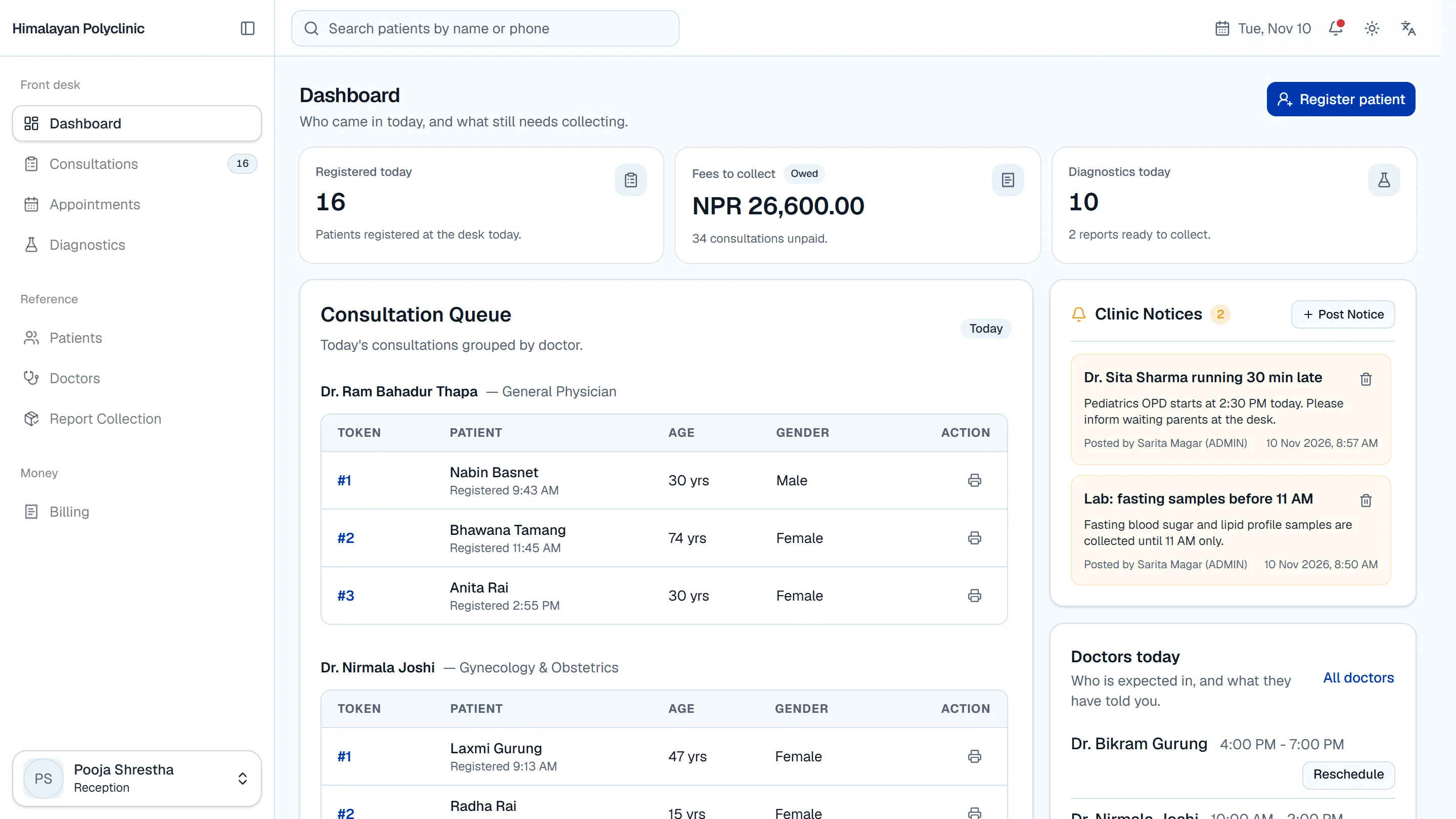
Rules we learned
at the counter
Seven days, same doctor
A follow-up is free only with the doctor the patient already saw, and only within seven days. PCMS counts the days, so reception doesn’t have to.
No patient files
The clinic keeps visits, not medical histories. Reception finds a patient by phone number, name and age.
Plaster is priced at the desk
A small plaster on a forearm doesn’t cost what one on a shin does. So reception types the price, and their name goes next to it.
Money taken is never edited
A refund is its own entry: money handed back, who handed it over and why. The payment it corrects stays exactly as it was.
Doctors are paid on the day
Each doctor is paid for the new patients they saw that day. Follow-ups earn them nothing, the same as before.
From first commit
to go-live
July 2026
We wrote down how the clinic worked, desk by desk, and started building.
August
The first plan was to run PCMS on the reception computer.
September
We moved it to a managed server instead, so nothing runs on the clinic’s own PCs.
30 September
The trial started. Staff used it at the counter every day, and what they ran into decided what we fixed next.
4–5 November
Live on its own server. The 13 doctors, 113 services and staff accounts came over from the trial without retyping. The trial’s patient and money records stayed behind.
6 November
First update. It took about a minute.
Kept safe
after launch
We didn’t hand over a login and leave. We run the server, and the clinic calls us directly when something looks wrong.
- Its own system and its own database
- Encrypted backups every night, kept in a second location
- A full restore tested before go-live
- An alert if a night’s backup doesn’t happen
- The server reachable only through a security proxy
Live since 5 November 2026
“We used to close the day not knowing what we’d actually earned. Now every rupee is on one screen before the last patient leaves.”